Anxiety: The Hidden Engine of Overfunctioning
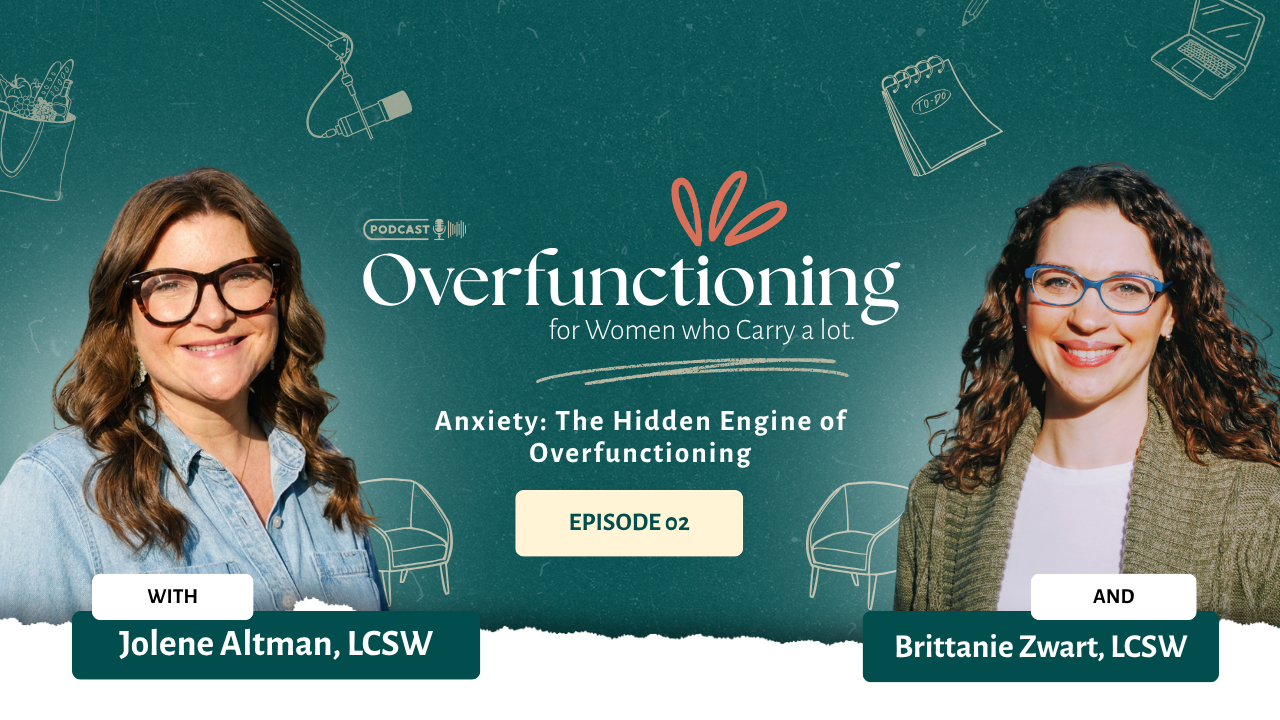
Written by Jolene Altman, LCSW, and Brittanie Zwart, LCSW, co-hosts of the Overfunctioning Podcast.
There is a common misconception about what anxiety actually looks like. Many of us assume that if we are not visibly hyperventilating or completely unable to leave the house, we must be fine. However, anxiety exists on a wide spectrum, ranging from a normal, healthy amount of worry that keeps us safe, all the way to clinical anxiety that deeply impacts our daily functioning and relationships.
For many women, clinical anxiety does not look like a traditional panic attack. Instead, it looks like extreme competence, overachieving, and perfectionism. In our therapy practices, we see this constantly: high-functioning anxiety in girls and women is frequently overlooked because their coping mechanisms actively serve the adults and systems around them. When an anxious young girl channels her nervous system dysregulation into getting straight A's, being endlessly helpful, and never causing trouble, she is not given psychological support. She is given praise.
Praised for Our Panic
We learn early on that people-pleasing and performing capability are the best ways to stay safe and secure. Over time, this anxiety becomes the invisible engine driving our overfunctioning. We take on everyone else's emotional weight, manage the group text, and anticipate every possible crisis because our nervous systems are stuck in a chronic, bodily state of "fight or flight". We subconsciously believe that if we just control our environment perfectly, we can prevent bad things from happening.
This praise reinforces a dangerous narrative: we begin to believe we need our anxiety to function. Anxiety is highly self-reinforcing. If we worry about something and it happens, we feel validated; if we worry and it doesn't happen, we credit our own hypervigilance for preventing the disaster.
The Midlife Collision: When Coping Skills Stop Working
You can run on the adrenaline of high-functioning anxiety for decades, but eventually, the body keeps the score. For many women, this breaking point happens right in midlife.
As we enter our late 30s and 40s, we encounter a chaotic collision of life stressors: sandwich-generation caretaking, career demands, and massive hormonal shifts. Perimenopause brings significant fluctuations in estrogen and progesterone, which severely impacts our mood and drastically lowers our physiological stress tolerance. Suddenly, the exact same overfunctioning strategies we have used our entire lives stop working.
You might find that your anxiety begins to manifest completely differently. Instead of channeled productivity, you might experience severe brain fog, sleep disruption, or a sudden, overwhelming sense of irritability. The emotional expression of your anxiety shifts, and you find yourself snapping at the people you love or feeling entirely "fried" after a normal day. The plate has not just gotten too full; your physiological capacity to carry the plate has shrunk.
Anxiety vs. Intuition: Learning the Difference
When your brain is constantly running through worst-case scenarios, it can be incredibly difficult to trust yourself. One of the most important skills we work on with clients is learning to differentiate between clinical anxiety and genuine intuition.
Anxiety is a trauma response: It is driven by fear, urgency, and the desperate need to protect yourself from a perceived threat. It feels loud, chaotic, and physically dysregulating.
Intuition is an inner knowing: It is grounded, calm, and clear. Even when intuition tells you something difficult, it does not send your body into a physiological panic spiral.
When we spend decades overfunctioning and ignoring our own needs, we completely disconnect from that internal intuition. Healing requires us to quiet the anxious noise enough to actually hear our own inner voice again.
Building Your Anti-Anxiety Toolkit
Healing requires daily, intentional maintenance. If you are in weekly therapy you still have 167 hours a week to regulate yourself and cope through stressors and unexpected chaos.
Here are a few practical places to start:
Prioritize Basic Fuel: We have to look at how you are eating. Many overfunctioning women skip meals or eat on the run, which signals to the nervous system that resources are scarce, instantly spiking anxiety. "Fed is best" for everyone not just babies, whether that means eating a quick handful of snacks or a full meal, you need a consistent eating routine to regulate your physiological baseline.
Manage Sensory Overstimulation: Modern life is incredibly loud, and sensory overload compounds clinical anxiety. If you are feeling chronically overwhelmed, look at your sensory inputs. Turn off the overhead lights, eat crunchy food to ground your jaw, put in noise-canceling headphones, or step away from the chaotic group texts. Giving yourself sensory breaks is a powerful form of boundary setting.
Build Distress Tolerance: Start intentionally practicing discomfort. The next time an issue arises, do not immediately rush in to solve it. Sit in the silence. Let the awkward pause hang in the air, and allow other capable adults to step up and handle the problem instead.
Look for Glimmers: You cannot out-schedule or out-work midlife anxiety. You have to learn how to soothe your nervous system from the inside out. And that is where glimmers come in. The term “Glimmers” was coined by licensed clinical social worker Deb Dana within Polyvagal Theory, glimmers are the exact opposite of triggers (triggers cue your nervous system that there is a threat). They are micro-moments of safety, connection, or peace that signal to your nervous system that you are okay. When you are trapped in an overfunctioning loop, your brain is actively scanning the horizon for the next threat (a missed email, a moody teenager, a text from a doctor). You literally become blind to glimmers. Here is how we begin to notice glimmers in therapy: Catch the Overfunctioning: Real-time awareness: Notice when your body goes into overdrive. Are you franticly tidying up at 11:00 PM? Are you answering a text for your partner that they could easily answer themselves? Pay attention to the physical sensation of urgency.
Implement the Strategic Pause: Interrupt the loop. Take one deep breath. Ask yourself: "What is actually mine to carry right now?" and "What would happen if I let this drop for five minutes?" Scan for a Glimmer: Micro-dosing safety. Intentionally shift your attention to a micro-moment of calm or beauty in your immediate environment. It could be the warmth of the coffee mug in your hands, the way the morning light hits the kitchen counter, the sound of your dog breathing on the floor, or a genuinely funny text from a friend. Savor It for 20 Seconds:Rewire the brain. Don't just look at it — feel it. Let the warmth or peace register in your body. It takes about 15 to 20 seconds of sustained attention for a positive experience to start knitting its way into your neural pathways, signaling your nervous system to come down from high alert.
Overfunctioning is incredibly heavy armor to wear. If you are ready to start setting it down, we are here to help you navigate the discomfort of finally taking it off.
Get in Touch
If you are finding it difficult to incorporate these strategies into your life or need more personalized support, please feel free to reach out. We can work together to create a practical, easy-to-use toolkit of coping skills tailored just for you.
Brittanie Zwart, MSW, LCSWTherapist and Advocate for Women’s Well-Being Brittanie is an LCSW offering online therapy for women in Missouri, Illinois, and St. Louis. She specializes in helping high-achieving, overfunctioning women navigate challenges with ADHD, boundaries, self-esteem, and emotional overwhelm. Through her empathetic and relatable approach, Brittanie empowers women to prioritize themselves, overcome burnout, and create lives that feel balanced and fulfilling.
Jolene Altman, MSW, LCSWTherapist for Overwhelmed, High-Functioning Moms Jolene is an LCSW offering online therapy for mothers throughout Illinois. She specializes in working with overwhelmed, over-functioning moms navigating late-diagnosed ADHD, anxiety, perimenopause, and mid-life stressors. Through her grounded and deeply human approach, Jolene helps women step away from the pressure of constant productivity to regulate their nervous systems, overcome burnout, and reconnect with their authentic selves.
Want to dive deeper?
Catch the full conversation on the Overfunctioning Podcast, co-hosted by Jolene Altman and Brittanie Zwart: