The Anatomy of Over-Functioning
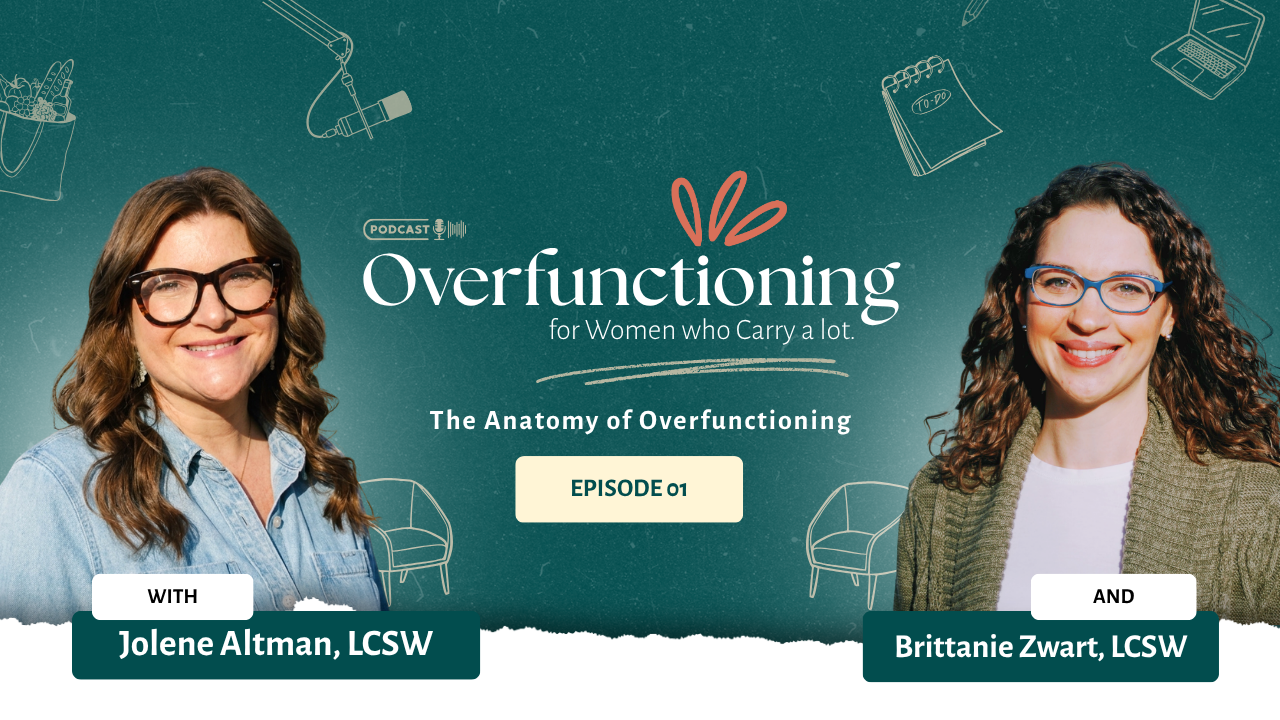
Written by Jolene Altman, LCSW, and Brittanie Zwart, LCSW, co-hosts of the Overfunctioning Podcast.
Have you seen that recent AI billboard going around? It says, "She will always show up. She will never call in sick. She will always tend to whatever you need." What are they selling? Artificial Intelligence. But notice the pronoun. She. The feminization of this flawless, tireless, never-sick entity is not an accident. Society has spent generations conditioning women to be the ultimate AI: always available, constantly anticipating needs, and never dropping the ball.
If you are a high-capacity woman, an oldest daughter, or a midlife mom, you probably know this role intimately. You are the "Cruise Director" of your family, the default manager carrying the invisible mental load for everyone around you. You are the one who knows everyone's shoe size, the exact schedule for Tuesday's tie-dye event, and the emotional temperature of the room the second you walk into it. You are highly competent, but there is a massive difference between competence and over-functioning. One is a skill, while the other is a trauma response disguised as productivity. In our practices, we talk with women every day about why they are carrying so much, what it is costing them, and why being told to "just ask for help" is the most useless advice you can get.
What Does Over-Functioning Actually Look Like?
Over-functioning is not just about doing chores or being organized. It is an identity wrapped up in keeping your nervous system feeling safe, and it shows up in sneaky, invisible ways. For example, there is an internet joke about the "Magic Table." A husband tells his stressed wife not to worry about the mess, saying, "Just put it on the magic table. Things just disappear and get done." The wife stares at him and says, "Who do you think is the magic table? I am the magic table." Over-functioners are the magic tables of their households and workplaces. We solve problems before anyone else even registers that a problem exists.
It also looks like the "underwear phenomenon." This happens when you spend three weeks anticipating the needs of everyone in your family for a vacation by packing the snacks, the sunscreen, and the specific sleep sacks. Then you arrive at the hotel and realize you forgot to pack your own underwear. You were so busy anticipating everyone else's needs that you completely disconnected from your own.
As one of our clients perfectly put it, "I am the adultiest adult I know." When there is a crisis, everyone looks at you. You have the answers, or at least you know how to find them, and you are praised for your maturity. But internally, you do not feel like the adult; you just feel cornered into the role because no one else is stepping up.
Why Do We Do It? (The Root of the Hustle)
Over-functioning rarely comes from a desire to control. Instead, it comes from a desperate need for safety and connection. Research shows that girls are socially conditioned from early childhood to be noticers, while boys are conditioned to be helpers. A helper awaits delegation, sitting on the couch until someone asks them to take out the trash. A noticer generates the list. They scan the room, see the trash is full, notice the dog needs water, and realize the house is out of paper towels. When a noticer sits next to a helper, the noticer's nervous system cannot relax. They are doing the invisible labor of managing the entire environment, while the helper believes they are "off duty" because no one handed them a task.
Women have also literally had to over-function to prove their economic and social worth. It was not until 1974 that women in the U.S. could legally open a checking account without a male co-signer. Our mothers and grandmothers had to anticipate the needs of men to secure their own financial safety and housing, and we carry the echoes of that hustle today. Furthermore, for neurodivergent women, over-functioning is often a mask. In our therapy practices, we see this constantly. If you have ADHD, your brain works at a million miles an hour, and you might carry a deep fear of being "too much" or dropping the ball.
Enter Rejection Sensitive Dysphoria (RSD), which is a severe physiological response to real or perceived criticism. To your nervous system, someone not liking your gift or being mildly annoyed with you does not just feel like a bummer. It feels like a tiger is chasing you. So, you over-function. You bring the best gift to the party, you over-deliver at work, and you anticipate every need so that no one can ever criticize you, reject you, or kick you out of the group.
The True Cost of Holding It All
You can only be at the magic table for so long before the legs give out. If you are hitting a wall of burnout, this is likely why. Resentment is baked into modern motherhood. When you are the designated emotional container for everyone around you, eventually the people you love start to feel annoying. Their texts are annoying, their needs are annoying, and their ability to rest while you cannot is infuriating.
This leads to the "productive rest" trap. Over-functioners cannot just "rot on the couch." We require permission to rest, and we usually only grant it if we can frame the rest as "productive" (like needing rest to be better at work tomorrow). We have been conditioned to view stillness as a moral failing.
The great irony of over-functioning is that you are surrounded by people who need you, yet you feel completely isolated. Because you are always the strong one, you never learn how to be vulnerable or share your messy parts. You assume that if you tell someone you are drowning, they will just give you another task. You do not want solutions; you just want someone to notice you are underwater.
The Un-To-Do List: How to Start Setting It Down
You cannot turn off a lifelong trauma response overnight, but you can start interrupting the pattern.
Let the ball drop (just once). Identify one low-stakes task this week. Do not anticipate it. Do not manage it. Let it fail. Notice that the world does not end.
Stop offering the life raft. The next time a capable adult in your life is mildly inconvenienced, do not jump in to solve it. Bite your tongue. Let them figure it out.
Rest without an agenda. Take 15 minutes to literally stare at the wall. Do not listen to a podcast. Do not plan dinner. Let your nervous system experience non-productivity without panic.
You do not have to earn your space on this earth by being endlessly useful. You are allowed to be tired. You are allowed to take your cape off.
FAQ: Real Talk About Therapy & Burnout
I am an over-functioner. How do I start therapy when adding one more appointment feels exhausting? This is the biggest hesitation we hear from high-achieving women looking for a therapist. Our answer is always the same: therapy is not another item for your to-do list. Our sessions are one hour a week where you do not have to hold the emotional weight of the room. You show up messy, and we carry the mental load.
Is my exhaustion burnout, ADHD, or Perimenopause? Honestly? It is usually a chaotic cocktail of all three. The dropping estrogen levels in perimenopause severely exacerbate ADHD symptoms and drastically lower your stress tolerance. Through neuro-affirming therapy, we untangle what is hormonal, what is neurodivergent, and what is simply the result of carrying too much invisible labor.
If I stop over-functioning, will everything fall apart? Some things might. But here is the hard truth: if your household or workplace completely collapses the minute you enforce a boundary, it was built on a foundation of your exploitation. We work on building a tolerance for the discomfort of letting other adults manage their own lives.
Get in Touch
If you are finding it difficult to incorporate these strategies into your life or need more personalized support, please feel free to reach out. We can work together to create a practical, easy-to-use toolkit of coping skills tailored just for you.
Brittanie Zwart MSW, LCSWTherapist and Advocate for Women’s Well-Being Brittanie is an LCSW offering online therapy for women in Missouri, Illinois, and St. Louis. She specializes in helping high-achieving, over-functioning women navigate challenges with ADHD, boundaries, self-esteem, and emotional overwhelm. Through her empathetic and relatable approach, Brittanie empowers women to prioritize themselves, overcome burnout, and create lives that feel balanced and fulfilling.
Jolene Altman MSW, LCSWTherapist for Overwhelmed, High-Functioning Moms Jolene is an LCSW offering online therapy for mothers throughout Illinois. She specializes in working with overwhelmed, over-functioning moms navigating late-diagnosed ADHD, anxiety, perimenopause, and mid-life stressors. Through her grounded and deeply human approach, Jolene helps women step away from the pressure of constant productivity to regulate their nervous systems, overcome burnout, and reconnect with their authentic selves.
Want to dive deeper?
Catch the full conversation on the Overfunctioning Podcast, co-hosted by Jolene Altman and Brittanie Zwart: